An automation is one sentence with three parts: when this happens, only if these match, then do this. Arbour ships five of them and you can write your own. They live in Settings, under Automations.
Open automations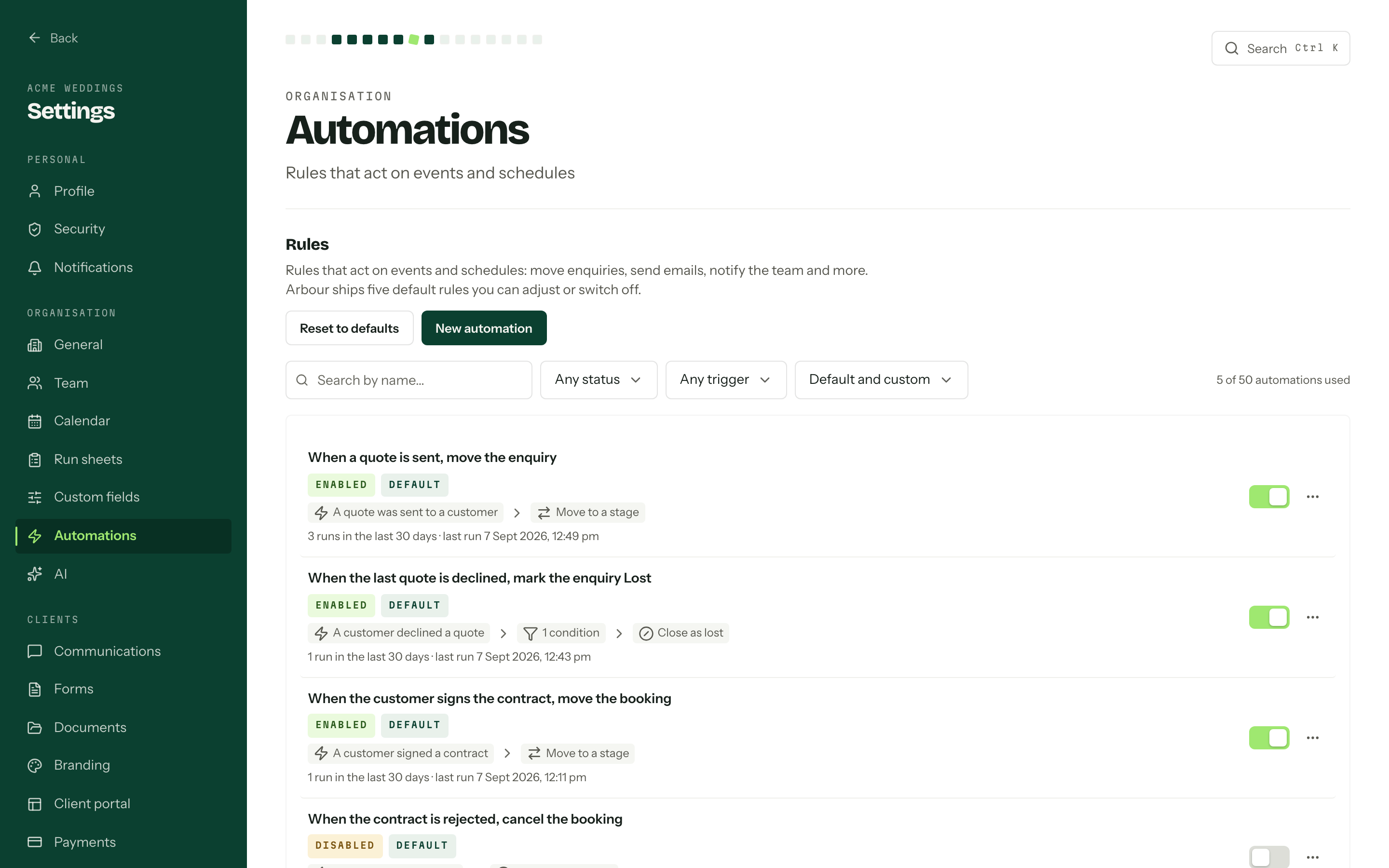
What starts a rule
Runs is the first choice in the editor, and it changes everything after it.
- When something happens watches for an event: a quote accepted, a contract signed, a payment taken. Pick it from the gallery on the new rule page.
- On a date around the event counts days before or after the event date, at a time of day you choose.
- On a schedule repeats daily, weekly or monthly.
Conditions narrow it. Leave them empty and the rule runs every time; add some and it runs only when they match, checked again at the moment it fires rather than when it was queued.
Steps are what happens, in order: notify members, send an internal email, send a customer email, move an enquiry or booking to a stage, close one, assign members, log an activity, call a webhook, or wait a while before the next step. A rule with a webhook step gets a signing secret, shown once when you save it. See Webhooks.
The rules you already have
Five default rules come with every organisation, marked Default on their card, and they are yours to change or switch off:
- When a quote is sent, move the enquiry
- When the last quote is declined, mark the enquiry Lost
- When the customer signs the contract, move the booking
- When the contract is rejected, cancel the booking
- When the confirming payment succeeds, move the booking
Reset to defaults puts all five back to how they shipped and recreates any you deleted. Rules you wrote yourself are not touched. The Origin filter separates Arbour defaults from Created by us, and the count on the right of the filter row tells you how many of your plan's automations are in use.
Pausing a rule
The switch on a card enables and disables a rule without opening it, and it asks first, because enabling one means matching events can start it straight away. A disabled rule stops being started by new events and schedules; anything mid flight is not retrospectively undone. Duplicate in the row menu is the safer way to try a change: copy the rule, edit the copy, leave the original off.
Draft, enabled, disabled
A rule saved without being switched on sits as Draft and never fires. It is the state to leave something in while you are still deciding.
Runs and steps
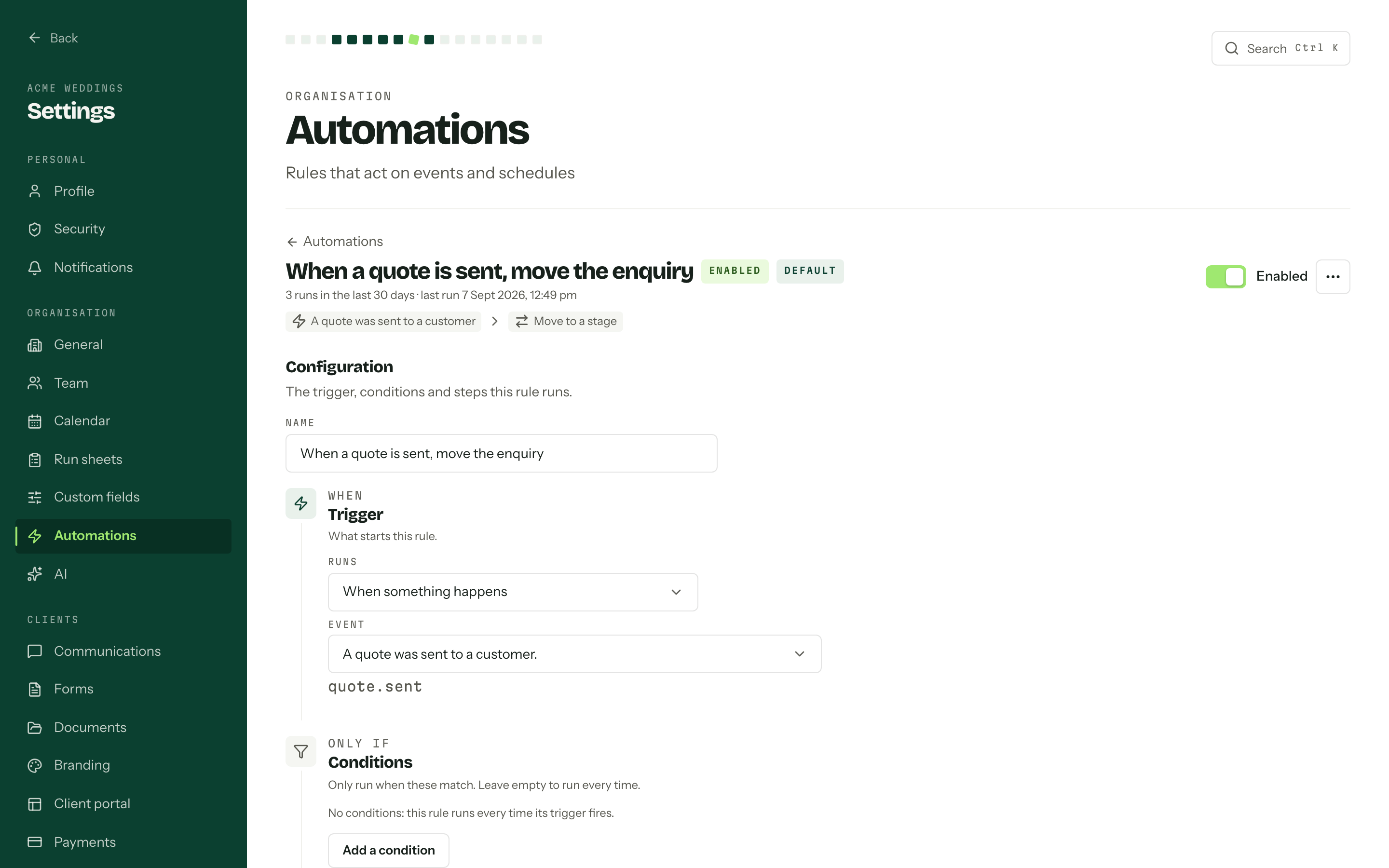
Open a rule and Run history shows the last 30 days, newest first: the record it ran against, what started it, and where it got to. Succeeded and Failed are self explanatory. Waiting is a rule sitting on a wait step, with the time it resumes. Skipped and Cancelled say why in plain words, the common ones being that the conditions no longer matched or that a later event superseded the run.
Steps on a run expands it into the individual actions, each with its attempt count and outcome. A failed step has its own Retry, so a webhook that was down for ten minutes does not cost you the whole run.
Who can use them
Automations need the permission to manage automations. Members without it do not see the page at all, and the API refuses them the same way. See Team and roles.