Two assistants share this page. The writing assistant drafts and rewrites emails using your own words as its brief, and Arby answers questions about your records. Neither sends or changes anything: a draft is a starting point that whoever is writing can change, ignore or throw away. This page is where the writing half learns what to sound like.
Open AI settings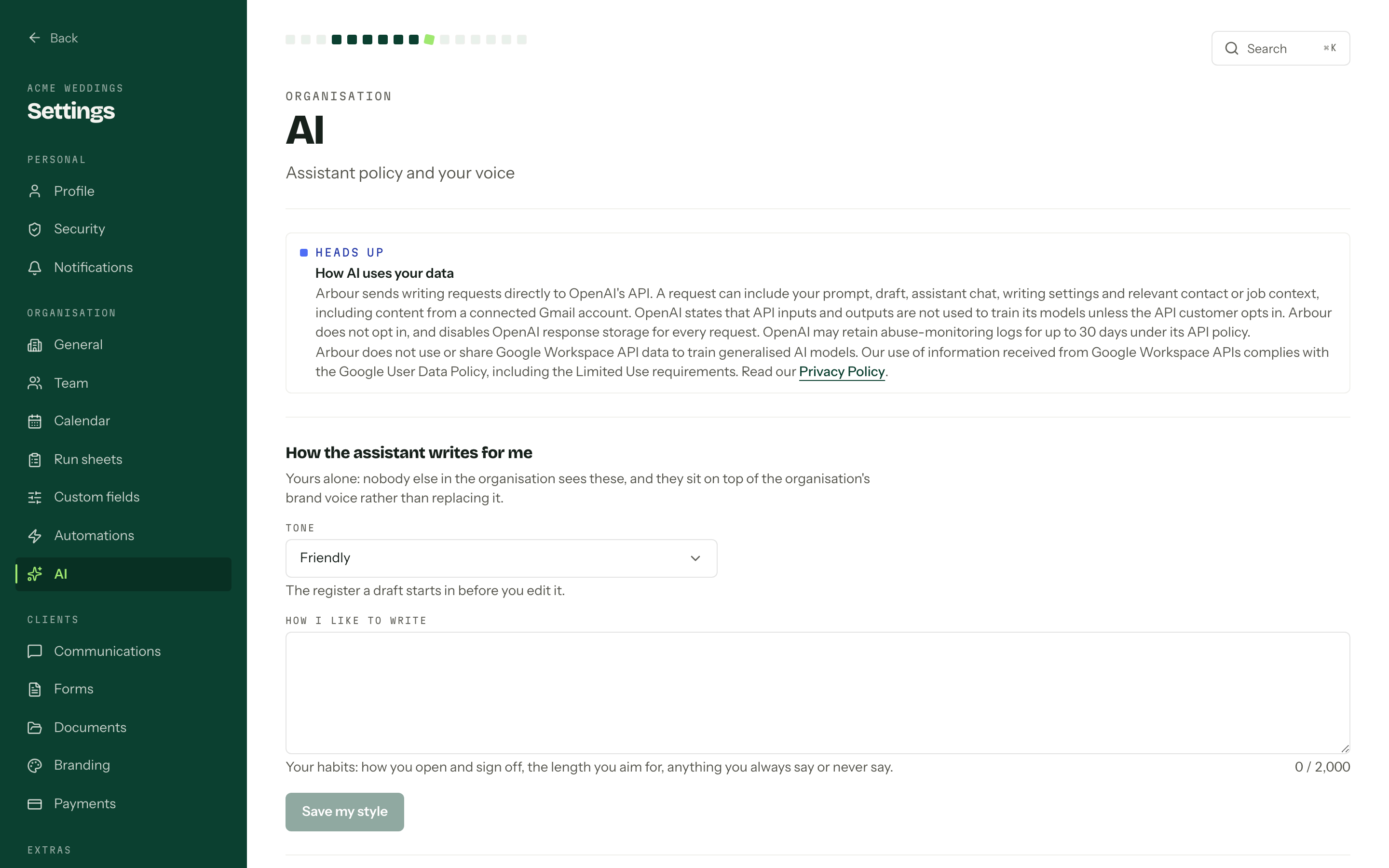
Two halves, two save buttons. The top half is yours alone and nobody else in the organisation sees it. The bottom half is the organisation's, and everyone writing from it gets the same brief.
How the assistant writes for me
Tone sets the register a draft starts in: Formal, Friendly, Casual, Concise or Warm. How I like to write is the free-text half: how you open and sign off, the length you aim for, anything you always say or never say. Save my style writes both, and they sit on top of the organisation's brand voice rather than replacing it.
The assistant across the organisation
AI assistant is the switch, and it covers both. Turn it off and the assistant disappears from the composer and Arby disappears from the top bar, for everyone in the organisation.
Three text boxes follow, each capped and counted as you type:
| Field | What belongs in it |
|---|---|
| Brand voice | How you sound: the words you use, the greetings and sign-offs you prefer, how formal you are. |
| About the business | Your history, the services you offer and what makes you different from anyone else your clients are talking to. |
| Things to avoid | Phrases you never use, promises you cannot make and topics that stay off an email. |
Save for the organisation writes all three. Changing them takes the Manage AI settings permission; without it the fields are read-only and the page says so.
Where the assistant turns up
In the email composer. Assistant sits in the composer header and opens a column beside the email you are writing, or a second tab on a narrow screen. See Inbox.
Ask for a first draft, or for a change to what you have written. When the assistant proposes a body it shows underneath the reply with Apply and Discard; applying drops it into the editor, and Undo puts your own text back. The chat menu at the top holds New chat and Delete chat, so a long thread can have more than one line of thinking going. The corner reads Writing as, followed by your tone, linked straight back here.
Using either assistant takes the Use the AI assistant permission. A role without it sees "No assistant on this role" on the top half of this page.
Arby
The second assistant is a question, not a draft. Arby sits in the top bar beside Search, or ⌘ J from anywhere, and answers from your bookings, contacts, money, calendar, email and settings. It reads only what your role can already see. The brand voice and writing style on this page are the writing assistant's alone; Arby has its own. See Arby.
What gets sent
The disclosure at the top of the settings page is the honest version, and it is worth reading in full. In short: Arbour sends assistant requests directly to OpenAI's API. A writing request can include your prompt, the draft, the assistant chat, the writing settings on this page and relevant contact or job context, including content from a connected Gmail account. A question to Arby can include the question, the chat so far and whatever Arby reads to answer it.
Permissions still apply to context
The context is built from what the person writing is allowed to read. A member who cannot see payments does not get invoices in the brief, and there is a size budget, so the least important slices drop out before the request goes anywhere.
If a deployment has no AI provider key, the page says the assistant is not configured yet and the switch has no effect. Neither assistant runs. Everything you write here is still saved, and applies the day a key is added.