Separate from the mail you write yourself, Arbour sends a small set of emails to your clients: the quote link, the invoice, the receipt, the contract. This page decides which of them go out, what they say and which address they come from. It lives in Settings, under Communications, on the Client emails tab.
Open client emails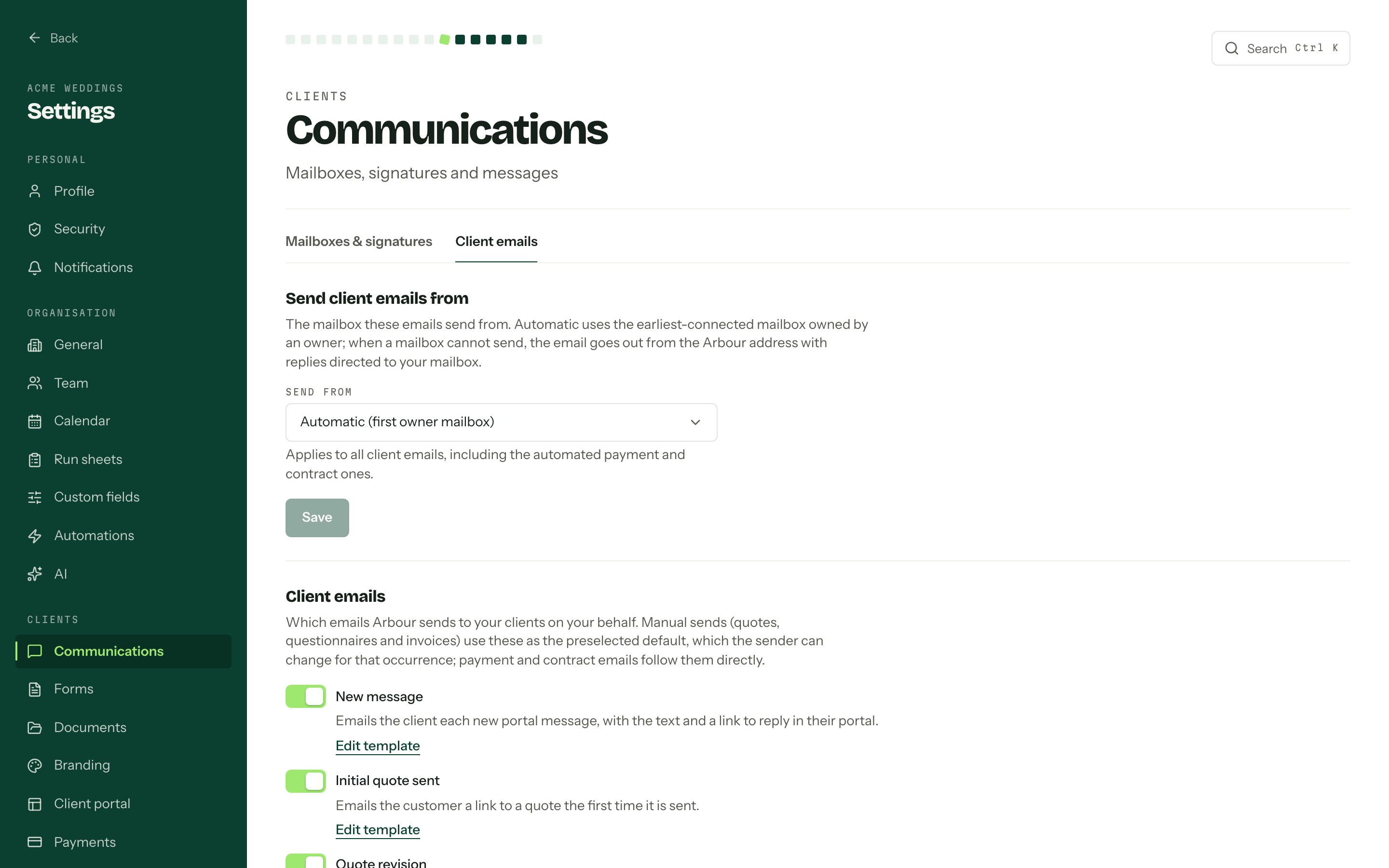
The emails
Eleven touchpoints, each with a switch and its own template.
| Message | Sent when |
|---|---|
| Initial quote sent | A quote goes to the customer for the first time |
| Quote revision | A sent quote is republished with changes |
| Initial questionnaire sent | A questionnaire goes out for the first time |
| Questionnaire revision | A sent questionnaire is republished with changes |
| Invoice issued | An invoice is issued |
| Invoice revised | An issued invoice is edited or adjusted |
| Payment receipt | A payment succeeds |
| Payment failed | A payment attempt terminally fails |
| Contract ready to sign | The contract document is ready to sign |
| Contract completed | The contract is fully executed |
| New message | A team member sends a message through the portal |
The switches work differently for the two halves. Quotes, questionnaires and invoices are sent by a person, so the switch is the preselected default and the sender can change it for that one occasion. Payment, contract and new-message emails follow the switch directly.
New message emails
With New message on, each message a team member sends through the portal triggers one email immediately. The email includes the message text, with a Reply in your portal link. It does not include attachments. There is no email review step and messages are not grouped into a digest.
The template can use {{ message.body }} and {{ message.sender_name }}. Email replies go to your mailbox and do not appear in the portal conversation. Turning this email off does not turn Messages off.
Where they send from
Send customer emails from picks the address. Automatic (first owner mailbox) uses the earliest connected mailbox belonging to an account owner, or you can name a particular mailbox, or choose Arbour default to send from the Arbour address.
Whichever you pick, it applies to all of them, receipts and contract notices included. When a mailbox cannot send, the email still goes out from the Arbour address with replies directed back to your mailbox, so nothing is lost while a mailbox waits to be reconnected.
Changing the wording
Edit template beside a message opens its subject and body with the merge fields that message can use, including your own custom fields. The preview on the right renders the saved template with sample values, so what you see is what the client gets. Save template commits it and refreshes the preview; Reset to default brings the built in copy back, and is only available on a template you have customised.
Leave the portal link in
The body has to keep the {{ portal.url }} field, so a client can always reach their portal from the email. A plain portal link is always included below your message. Customer emails keep your message formatting without added Arbour branding, headings or footers, whichever address sends them.
Reviewing before it goes
Review emails before they go is on by default. With it on, sending a quote, questionnaire or invoice (or a revision of one) opens the email first, for the sender to read, adjust, add recipients to, or discard while still performing the action itself. With it off, the saved template goes straight out whenever Email customer is ticked. Untick that and there is no email either way.
The setting applies to everyone in the organisation. Automatic emails never stop for review.
Who can change this
Everything on this page needs the permission to manage customer communication defaults. Without it the page is readable but not editable, and says so. See Team and roles.