An invoice belongs to a job, so it lives on that job's Money tab beside its quotes. From anywhere in the console, Raise an invoice asks which job first and drops you on the right card.
Raise an invoice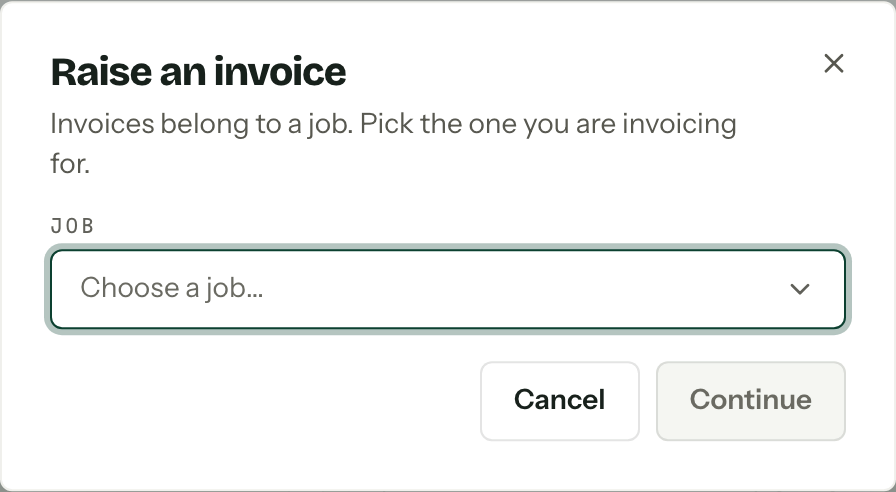
Raise one
- 01
Pick the Job and press Continue. Nothing is created yet; you land on the job's Money tab.
- 02
Press New invoice. That makes a private draft and opens it. Where you keep more than one payment plan, choose one first; Default plan is assumed otherwise.
- 03
Under The invoice, press Add line for each item: a name, a quantity and a unit price.
- 04
Check Payment, which is the instalment schedule the plan brought with it, and Bill to, which fills itself from the job's primary contact.
- 05Press Issue invoice.
An accepted quote does all of this for you: acceptance issues one invoice from the accepted revision, with the same lines, the same GST and the plan resolved against what the client chose.

Deposit, instalment, balance
There is no invoice type to pick. A deposit is the first instalment in the Payment section, and the balance is the last. Each row has a Name, a Charged as of Fixed amount, Percentage or Remainder, a Due rule, and its own tick list of what it can be paid with. Full detail in Payment plans.
The invoice's own due date is worked out at issue from the last instalment to fall due, so there is nothing to type. Exactly one instalment is payable at a time: the earliest one still owing.
Issuing
Issuing is the moment the document becomes real. It takes the next invoice number, freezes your GST position and seller details onto it as they stand, and publishes it to the client portal. If you are registered for GST it is headed Tax invoice; otherwise, Invoice.
A number is spent, not borrowed
Numbers are never reused. A draft can be deleted and leaves no trace; an issued invoice can only be voided, and the void stays on the record. See Document numbering.
Issue options beside the button holds the Email customer tick, which decides whether the client gets the invoice by email as well as in their portal.
What the client does
The portal lists Your invoices and opens each one as a document they can download as a PDF. On the instalment that is due they get whichever methods you offered it with: Pay by card hands them to Stripe's hosted checkout, Pay by bank transfer shows your account details with a reference like INV-000001-02 to quote, and Pay by cash shows your instructions. If the job's quote carried an unsigned contract, paying waits until it is signed.
Revisions, adjustments and payments
Saving an issued invoice sends a revision. If the change moves money or GST, Arbour asks for a Reason (required), writes an immutable adjustment note against the invoice, and expires any card payment the client had open. Money already collected cannot be taken back off, and a paid instalment cannot shrink. Refunds are done from the Stripe Dashboard, not here.
There is no mark as paid. Money arriving any other way is entered in the Payments section with Record payment: a Method of Bank transfer, Cash or Other, an Amount (AUD) and a private Reference. Part payments are fine. Unpaid, partially paid and paid are worked out from the ledger, so the two never disagree.
Creating and issuing needs the create, edit, issue and void invoices permission; recording money needs record manual payments, which is a separate one. See Team and roles.