Every organisation has exactly one public enquiry form. It lives in Settings, under Forms, on the Enquiry tab. Someone fills it in on your website, a new enquiry lands in the pipeline with their answers attached, and nobody retypes anything.
Open the enquiry form
The link and the switch
The Contact form section carries a Live or Off badge, the public URL and a Copy link button. The URL is your portal address followed by /f/ and the form's own id. It never changes, so it is safe to hand out or link from a website button.
Tick Form is enabled to take it live. Untick it and visitors get a not-found page, which takes down every embedded copy on your website at the same time.
Fixed details
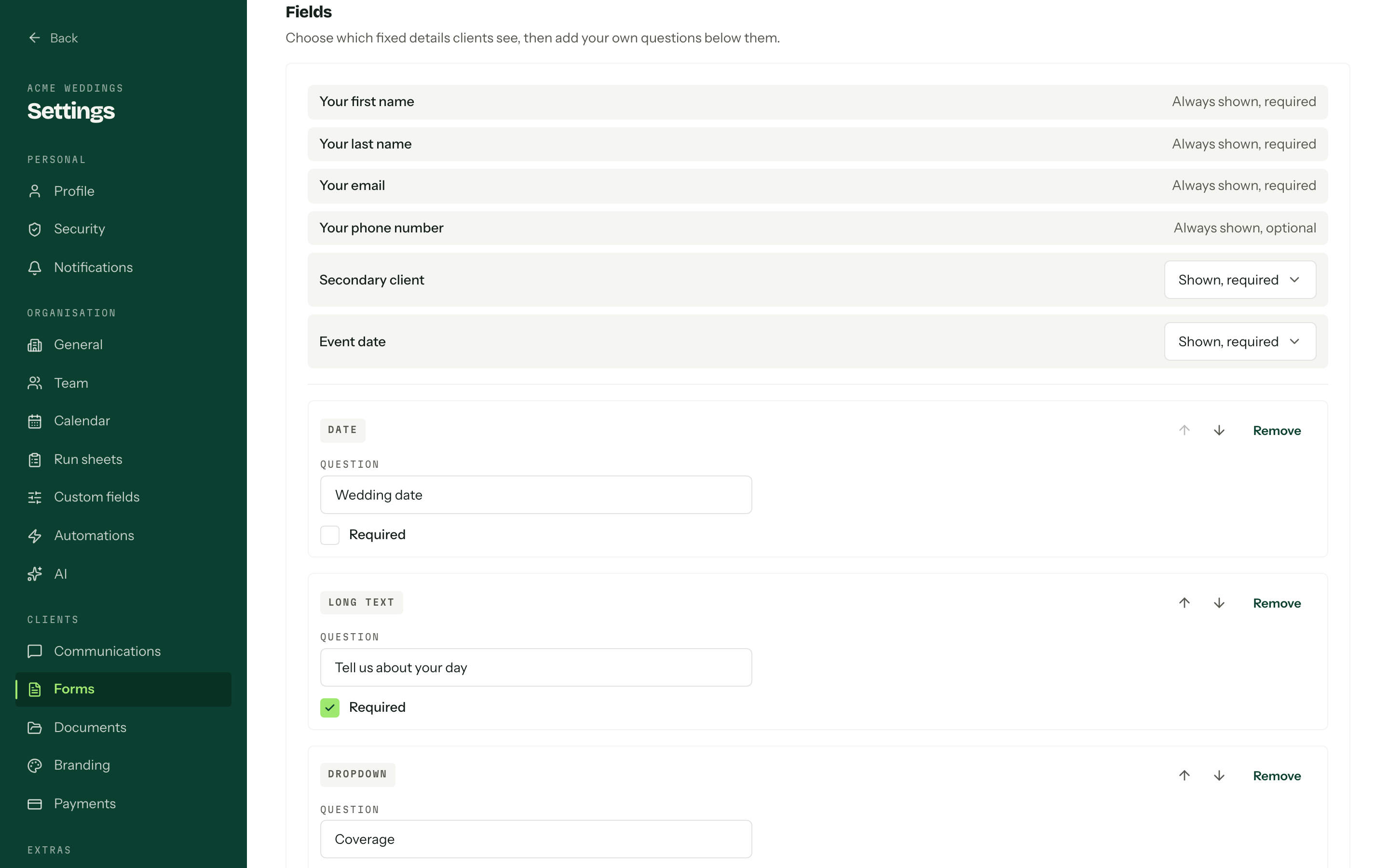
The top of Fields is the set every form asks for. First name, last name and email are always shown and always required. Phone number is always shown and optional.
Two rows are yours to set: Secondary client and Event date. Each takes Shown, required, Shown, optional or Hidden. An optional event date gives the visitor an "I don't have a date yet" choice, which is worth having for the couple who are still arguing about March.
Your own questions
A new organisation starts with a set of questions picked from the vendor types you chose at setup: how they heard about you, where the event is, guest numbers, anything else. They are ordinary questions, so rename, reorder or remove them as you like.
- 01
Press one of the add buttons at the bottom of the list: Add short text, Add long text, Add number, Add date, Add dropdown or Add checkbox.
- 02Type the question. A dropdown also takes its Options (one per line).
- 03
Tick Required if an answer is compulsory, then use the arrow buttons to move the question, or Remove to drop it.
- 04Press Save form. There is no draft: what you save is what the next visitor sees.
Answers into contact fields
An ordinary question stores its answer on the enquiry. A mapped question writes it to a contact field on the person instead, so a budget band or a preferred contact method is on their record from the first minute.
Pick a field under Insert a contact field, press Add contact field, then set Answer goes to: Primary contact, Secondary contact or Both. The control type and, for a dropdown, the choices come from the field itself and are read-only here. See Custom fields.
Secondary questions wait their turn
A question mapped only to the secondary contact stays hidden until the visitor enters secondary client details. One mapped to both is always shown and applies to a secondary contact only when there is one.
Where the answers show
Open the enquiry and the Enquiry answers card holds the lot, exactly as asked at the time. Later edits to the form never rewrite an answer already collected.
Above the answers is a source line: Source: Hosted form for the public page, Source: Website embed for a form on your own site. That is your lead attribution, and it is informational only. See Embedding the enquiry form.
Who can edit
Editing the form needs the manage the contact form permission. Without it the whole editor is read-only and a note says an owner or admin makes the change. See Team and roles.